Common Admin
Common Admin is the root-only global administration page at /en/admin/common. Users without root or global read-all access are redirected away.
Purpose
Use Common Admin for reusable configuration and runtime records that are not owned by a single agency detail tab. The page is configuration-driven, so each tab has a consistent table, form, validation, and lookup experience.
Resource order
The configured tab order is:
- GWCOA
- Entities
- Contacts
- Addresses
- Form Schemas
- Attachment Types
- Review Schemas
- Review Set Setups
- Review Setups
- Completions
- Review Sets
- Reviews
- Approval Templates
- Approval Steps
- Certifications
- Routing Slips
- Recommendation Schemas
- Recommendation Setups
- Recommendations
The order intentionally moves from base reference data to runtime execution records.
Common UI behavior
Each resource tab renders a table and generated form. Field types include text, number, date, textarea, JSON, boolean, enum, and lookup fields. Search includes configured columns and the id. The deleted filter supports all, active, and deleted records. For editable resources, an existing row exposes a deleted switch so root users can soft-delete or restore records.
The Entities tab is read-only. It supplies runtime entity ids for lookup fields and should not be hand-created through the UI.
Reference resources
GWCOA, Contacts, Addresses, Form Schemas, and Attachment Types are foundational. They supply chart-of-account references, reusable people, reusable addresses, dynamic form schema JSON, and agency-filtered attachment type labels. Form schemas and attachment types can be agency-linked.
Review resources
Review Schemas define the actual review content and can be checklist or assessment style. Creating a Common Review Schema uses versioning helper logic to create a draft review schema value. Review Set Setups group reviews for an entity type and scope. Review Setups attach specific schemas to a setup and order them. Review Sets and Reviews are runtime records created from those setup definitions.
For proponent reviews, the runtime Reviews tab looks up review set setups for applicantrecipient, creates runtime review sets, groups review rows by review set, and opens assessment detail pages for individual reviews.
Approval resources
Approval Templates describe an approval workflow for a scope and entity type. Approval Steps define step sequence, default user, and approver title. Certifications can attach to approval steps and specify optional or required certification text. Routing Slips are runtime approval records tied to an entity and approval template.
Approval and completion sections do not become useful until templates, steps, users, certifications, and entity mappings exist.
Completion resources
Completions record whether a specific entity is complete, with comments, user, and completion date. Completion entity types include common review and recommendation records as well as funding case agreement child workflows such as intakes, amendments, monitors, claims, forecasts, payments, and recommendations.
Recommendation resources
Recommendation Schemas define structured recommendation content and result JSON for supported entity types. Recommendation Setups attach recommendation schemas and optional approval templates to a scope/entity type. Recommendations are runtime rows containing recommendation values and response JSON.
Operational guidance
Root users should not use Common Admin as a casual data editor. Many resources drive runtime workflows. Changing active schemas, approval templates, or setup records after runtime records exist can affect new records differently from historical records. Prefer adding a new version or new setup when the business process changes materially.
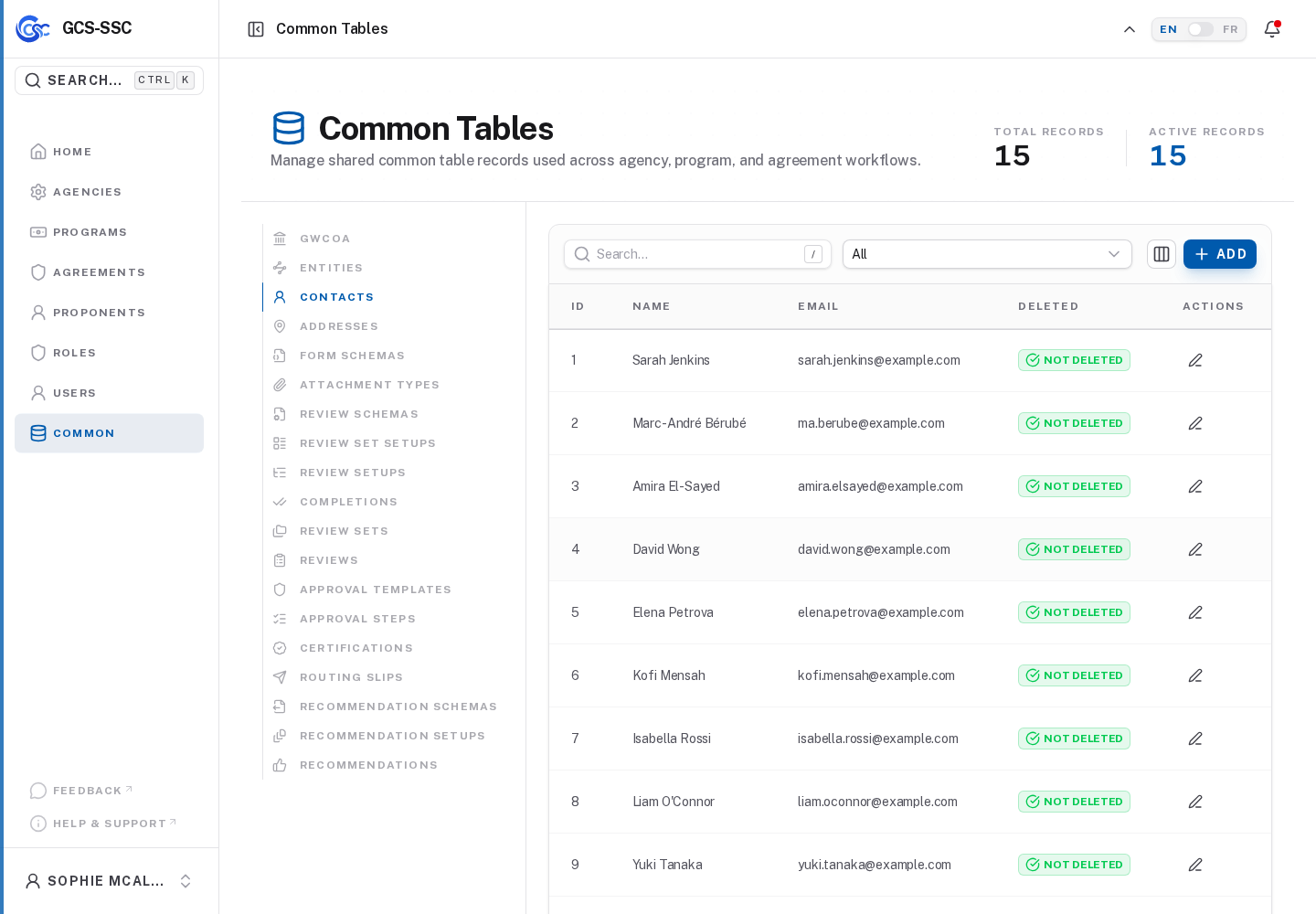
Actual screenshot from the seeded development environment. The records shown are examples only and are not created in a fresh installation.